
Tamil Nadu-based Lakshmi Vilas Bank (LVB) with pre-independence lineage on Friday lost its identity after its merger with the Indian subsidiary of Singapore's DBS Bank. The debt-ridden 94-year old old bank's fate was sealed with Union Cabinet headed by Prime Minister Narendra Modi approving Scheme of Amalagamation on Wednesday.

The syndicate used "stooge" bank accounts and shell companies to transfer the largest amount linked to a single case recorded in the city, the Customs and Excise Department of Hong Kong said.

The Supreme Court stayed the National Consumer Commission's order, which had capped the interest rate chargeable on credit card holders at 30 per cent. The verdict will allow banks to levy any interest rate they consider applicable to card holders. In their appeal, the banks said they were following the guidelines of the RBI, which was the only authority to regulate the fixing of the interest. The commission had no jurisdiction to pass an order directly to the banks.
Finance Minister P Chidambaram said on Tuesday the Reserve Bank of India and Indian Banks Association have no objections on raising bank credit to minorities but difference of opinions need to be reconciled before a policy position is brought out.
Bankers have requested RBI to keep interest rates stable this fiscal, in lieu of sufficient liquidity in the system.
The Indian Banks Association and Indian Cards Council have joined hands to set up a data of telephone numbers whose owners do not wish to receive telephone calls from banking telemarketers for financial products or services.\n\n
The government has asked the Indian Banks' Association to make sure that IDBI Bank's wages are on a par with other banks.
The Supreme Court on Monday admitted the appeals of Standard Chartered Bank, HSBC and Citibank challenging the order of the National Consumer Commission imposing restriction on charging credit card holders an interest rate in excess of 30 per cent.

The World Bank has approved loans totalling $1.75 billion (about Rs 13,834.54 crore) to fund India's PM Ayushman Bharat scheme and private investment to boost the economic growth. Of the total loan, $1 billion will go towards the health sector, while the rest $750 million will be in the form of development policy loan (DPL) to fill the financing gaps through private sector investment in the economy. The World Bank Board of Executive Directors approved two complementary loans of $500 million each to support and enhance India's health sector.
The Reserve Bank will take some action by this month end after consultations with the Indian Banks' Association.\n
This was discussed at a meeting chaired by the Prime Minister's Principal Secretary, TKA Nair, on January 12 with the Indian Bank Association, industry bodies and human resource development ministry officials.

The Centre on Monday extended the ban on terrorist group Students Islamic Movement of India (SIMI) for five years for its involvement in fomenting terrorism and disturbing peace and communal harmony in the country.

The decision is in response to the strike call given by United Forum Of Bank Unions, which has more than 10 lakh (1 million) employees and officers of banking Industry under its umbrella.

'The finance ministry and public sector banks have tried to keep the names of wilful defaulters secret.' 'Secrecy and concealing information are inbred among banks and even the RBI,' observes Debashis Basu, editor, www.moneylife.in.
The Reserve Bank of India will encourage banks to set up a payment corporation to streamline payment system.

India has received the fourth set of Swiss bank account details of its nationals and organisations as part of an annual automatic information exchange under which Switzerland has shared particulars of nearly 34 lakh financial accounts with 101 countries.

Severe heatwaves, responsible for thousands of deaths across India over the last few decades, are increasing with alarming frequency and soon the country could become one of the first places in the world to experience heatwaves that break the human survivability limit, according to a new report.
Electing Union Bank of India chairman V Leeladhar as the new chief, the Indian Banks Association on Thursday said it has constituted a committee to draw up a long-term perspective 'Vision Plan' for the banking industry.
Finance Minister P Chidambaram will meet bankers on June 3 to review operations of banks, firm up next generation banking reforms and set targets for credit flow to sustain 7 per cent growth in economy.
The Reserve Bank of India has asked banks to conduct extra due diligence of accounts operated by non-government organisations to monitor and reduce risks of money laundering.
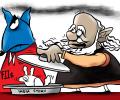
Foreign Portfolio Investors (FPIs) continued their buying spree and poured close to Rs 4,800 crore in the Indian equity markets in the first week of January driven by confidence in the country's robust economic fundamentals. Additionally, they injected Rs 4,000 crore in the debt market during the period under review, data with the depositories showed. With expectations of a prolonged decline in US interest rates in 2024, there is an anticipation that FPIs will likely escalate their purchase, particularly in the initial months of the New Year leading up to the general elections, V K Vijayakumar, chief investment strategist at Geojit Financial Services, said.

The value of the Indian Premier League went up 6.5 per cent to USD 16.4 billion (around Rs 134,858 crore) in 2024, according to a report by American investment bank Houlihan Lokey.
The government is not averse to mega merger of banks and financial institutions like IDBI and IFCI, if all stipulated norms of the Reserve Bank of India are met, Finance Minister P Chidambaram said on Wednesday.

It is to keep labour unions away and make the employees feel important.
While asking all members to fall in line and lower interest rates on bulk deposits, Indian Banks' Association on Monday said further reduction in term deposits rates for retail customers will depend on a fall in inflation.
The Reserve Bank of India is expected to kick off the pilot project on cheque truncation, which eliminates physical movement of cheques, in Delhi over the next 9-12 months.
The interest rates on deposits continue to be high despite ample liquidity due to monetary policy uncertainty and expectations that liquidity would tighten later this year. Banks are still offering peak interest rates of 9 to 9.5 per cent on deposits

As the new Tax Collection at Source (TCS) on foreign remittances is set to become applicable from October 1, travel agents' body TAAI has made a last-minute plea to the government, urging them to abolish the decision or defer its implementation until the next fiscal year to allow discussions on overseas tour packages. The government has raised the TCS on foreign remittances under the Liberalised Remittance Scheme (LRS) from 5 per cent to 20 per cent. This will be applicable to international travel, sending money abroad and other remittances.

It is also considering to hike FDI cap for public sector from 20 per cent to 49 per cent
The government is committed to ensure a smooth flow of education loans for students and a total of 1,40,000 such loans were given till last December, Finance Minister P Chidambaram said on Tuesday.

'When the bombing happened in the Taj Mahal hotel in 2008, that was a very sad moment, but he really took care of the people, took care of everybody and that was when you saw some of his best moments.' 'There are some things which we will never forget. That is when the best of a person comes out.'

'Investing abroad helps mitigate currency risk for foreign-currency denominated goals, such as children's higher education and international travel.'
